
On Portals...
... and storytelling

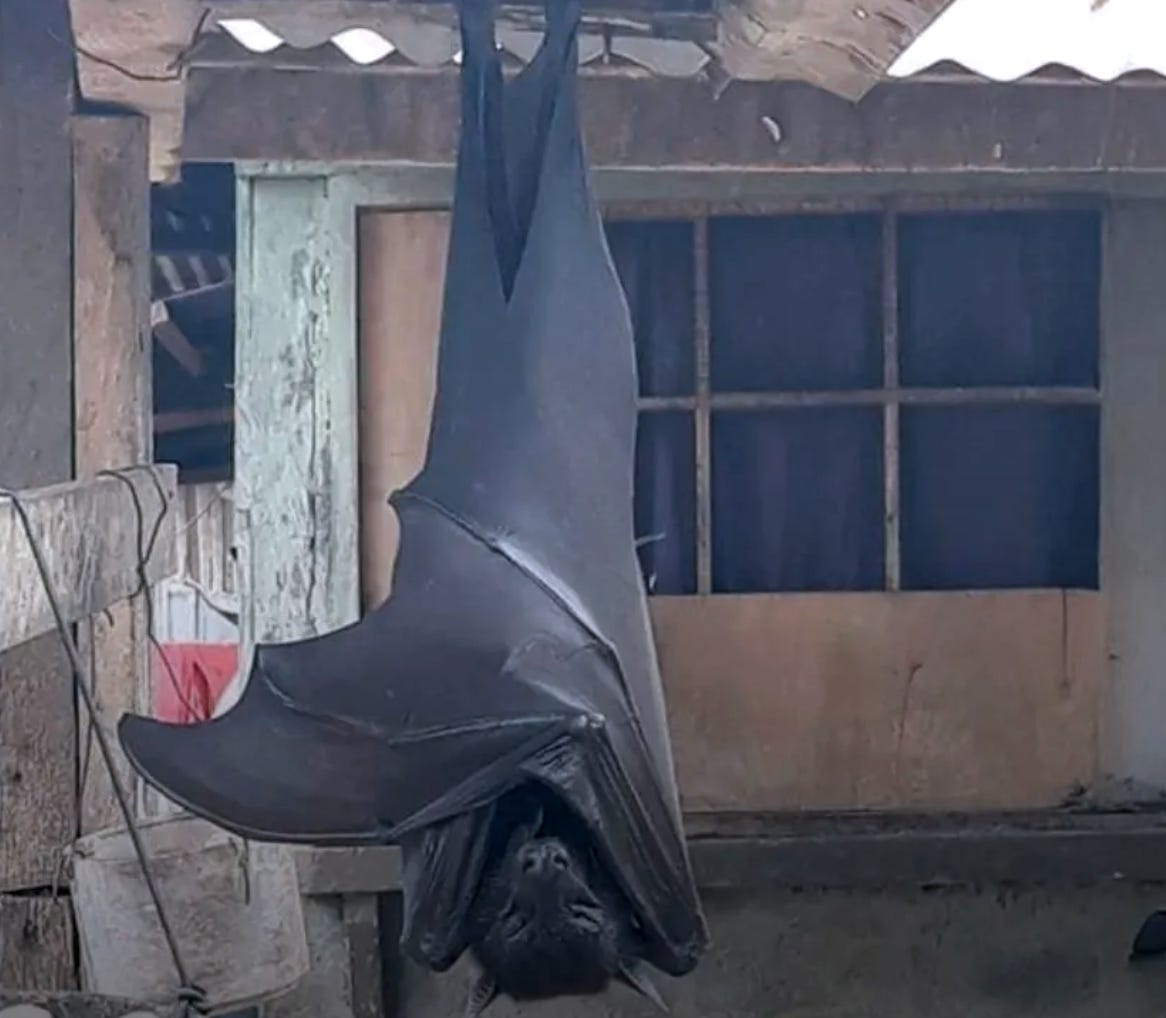
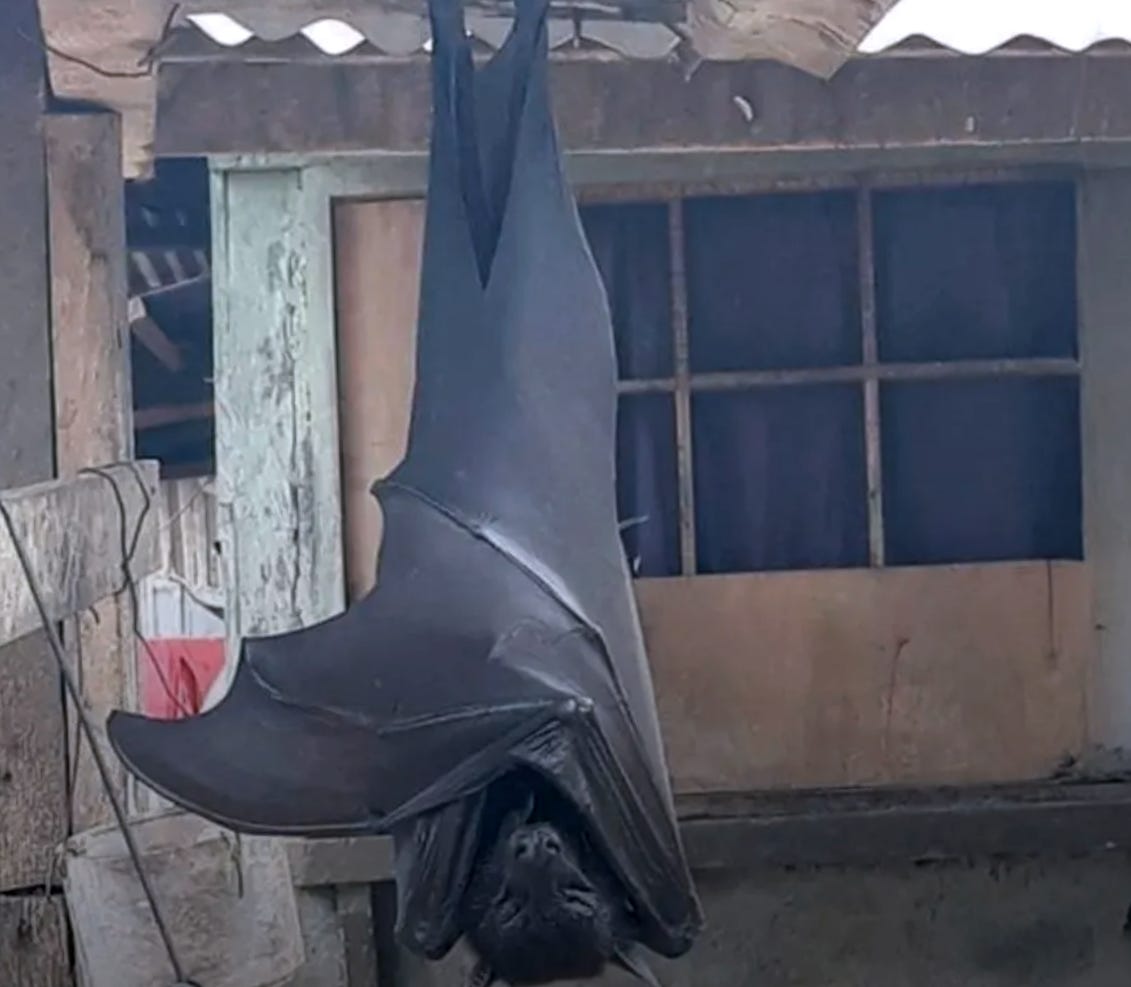
I sat around a table as darkness fell, in a garden behind the pavilion where I had, that night, completed my master’s program. The mood was celebratory and the ambient sound was loud with talk, music, and the occasional guffaw. Someone made exclamations about a human-sized bat and my partner, whose laughter is rippling and contagious, took the opportunity to use their critical thinking skills, and requested a source be found to confirm the size of this unbelievably large bat (see photograph). Somehow from there we got to the topic of portals, which, like the bat, was similarly fictional, and needed further explanation.
How to explain portals? Start with the concept of a doorway, but make it more of a threshold, and then stretch it through time, so the threshold becomes a tunnel, except that when you enter the tunnel and while you are in it, you probably don’t know that that is where you are. It is only later, when you feel that you are emerging, that you realize that there is narrative sense to this moment in life.
In other words, I believe that to go through a portal is to realize something that has been cooking for a long time. It is to have finally figured out how to process it, see it in a new light, or otherwise metabolize it. You are now able to find clues as to what has been going on. You have language for the way you are changing. Doesn’t this means that the change is most probably behind you? Before getting to this point, while you are in (what I am calling) the tunnel of the portal, there might be various hardships, but they don’t make sense or congeal into one narrative. When you come out the end, you can say to yourself ah, I am going through a portal. The process of recognizing that you have been going through the portal becomes the exit of the portal itself, and offers up the possibility of telling the story of that portal.
Several people dear to me have experienced major and minor portals this past year. Sometime in September, at the mouth of Leinestraße Ubahn, at the end of our walk, right in front of the Aldi, a friend explained her portal to me, breathlessly, as her dog waited, patiently. Her portal reset of how she conceived of her artistic resources. It involved using things she did have, like cardboard, friends, and music, as opposed to using things she didn’t have, like funding. She was realizing that so much of her artistic planning and imagining was based on debt, which wasn’t a great source for her imagination to draw from. If she would use the things at her disposal, she could work from surplus, both in the material and imaginative sense.
Those familiar with astrology might think of a planetary transit as a portal. Or if you have read Rachel Cusk’s Transit, a book in which the narrator is in a transitory state as her life shifts profoundly in the aftermath of a divorce, the portal takes shape as the old house she is renovating. She is forced to live in the discomfort of plastic sheets and exposed isolation, while her relationship with antagonistic neighbors goes from bad to worse.
Reading a book can be like going though a little portal. When you start, you don’t know how it will change you until it is over. Writing a book is a mega portal. Over the past few years, I watched my Dad complete his book, entitled “Diplomats at War: Friendship and Betrayal on the Brink of the Vietnam War,” which is, among other things, a book about his Dad. Finishing it was a feat that I don’t think he thought he would accomplish in his lifetime. When we spent time together at Christmas, I got the feeling he had fully emerged out the other side of the portal, because the reverberations of the book existing in the world, of people reading it and asking him to speak about it seem to have run their course. Although I wish for him to continue to revel in fanfare an accolades for as long as possible, I detected that he felt some peace in that this part of his story is over.
Portals are worth marking in time, I think. They are worth celebrating. As another friend came through a decade-long portal (which was actually a reoccurring once-in-a-decade portal), one of the ways she marked the time was to clear out her studio, sell old costumes, and, most remarkably, read all of her old diaries from the past 30 years, shred them, and turn them into several papier-mâché bricks that she would later burn at an undisclosed location.
A new year is a portal. I spent the first day of this year with three people I love incredibly dearly: my brother Henry, his partner Ashley, and Soph. The snow in Astoria bounced back the hard bright light of January 1st as we trudged through the wind, speculating about how effectively Roosevelt Island could barricade itself in the instance of a revolution. We ate breakfast at a diner that sat as the centerpiece of a strip mall, marveling at the chicken and waffles, and the way the cement-like texture of the milkshake held its wide straw straight up and proud. We binged-watched all six episodes of Heated Rivalry, rolling our eyes and weeping, and then wept some more when we capped off the day with Mamdani’s inauguration speech. It was literal perfection.
Coming back to the portal’s relationship to fiction - maybe we can consider how portals exist only if we go through them. Ghislaine Leung’s sculpture called Arches is an inflatable archway installed inside a gallery. Among other things, the sculpture uses the invisible infrastructure of the gallery, like air and electricity, making the visitors complicit to the infrastructural critique that the artist is playing with. Here is a quote from her book Bosses:
“I think the history of privilege has been about utilising [..] ties to extract, and then [..] cutting those ties, to retain. I think what’s important about acknowledging those ties and keeping them there is that there’s suddenly porosity again, which leads to a flood of questions. […] The works that are inflated archways, saying Welcome, called Arches, are very literaly dependent on air and electricity, they are dependent on something and also someone actually coming into them. The ability to welcome or for an institution to be accessed is dependent on a host of factors, a lot of other things that have happened already.”
I think Leung and my friend who renewed her relationship to her resources have gone through a similar portal: what is readily available is often the most politically potent material. What are we already tied to? How are those things tied to larger structures? How can we see those ties and make them work in more radical ways? Sometimes going through a portal just means that you learn to see things differently.
It took me a long time to write this essay because I was anxious about finding a portal of my own. I thought this text would only work if framed by a personal story of having emerged from my portal with new eyes. However, I am not, to my knowledge, coming out the other side of any sort of metaphysical tunnel. I am actually having one of the least esoteric phases of my life, plodding along, taking it day-to-day for the most part. But all the portals around me are interesting to me at the moment as prisms to perceive time, or as literary devices. A story can be anything, and each story is incredibly specific. A portal can be anything, and each portal is incredibly specific. I love esoteric phenomena for how they allow us to create narratives and myths out of things that are active and urgent and present in our lives. I can’t just make up a portal in order to frame this essay. Portals can be anything, but a portal isn’t just any old thing. As a writer I try to remember that you can make a story out of anything, but a story is not any old think. Stories have consequences; they’re a big responsibility!
Much love, and happy new year <3
Louise
PS: Today I took a break from editing this text to chat with an old friend. Various events in her life have shifted dramatically this month, and she said, “it’s like the universe is closing tabs.” I had to share it here — so related to portals!! — and also just an accurate and poetic description of a lot of stuff going on now, both the great and the horrible.
PPS: in another funny moment of synchronicity, an artist I admire named Sophia Cleary published this portal piece on their substack right as I finished the first draft of this one. Sophia’s essay is about a big portal they initiated without realizing it, which involved their parents and being an actor. It was a great read.

~ Announcements ~
+ I had the privilege of talking about prayer and prostration with Nabila Abdel Aziz on Deutschlandfunk Kultur Radio this past December. I took a lot of the ideas I was talking about from my forthcoming text entitled “Prostration: the Powers and Politics of Bending Over,” which should be published sometime in early spring. Here is a link to the whole episode and here is a link to my segment. It’s in German!
+ The premiere of Dictée by Francesca Ferarri went really well. The piece has so many details, it is so dense and atmospheric and uncanny. So much happens in just one hour. It made me feel like a swiss army knife of a performer. Really hope it will happen again.
+ I’ll perform in Nikima Jagudajev’s work Basically again soon in Brussels! Come through and get tickets if you are there. It looks like this is the last time for a little while that this work gets shown – don’t miss it. But I hear there is a new work on the way…